
Pool Equipment Repair on Oahu
Pumps, heaters, salt cells, automation, and pool lights — the licensed, insured pros we work with diagnose and repair the equipment that keeps your pool running.
Get a Free Quote
Tell us what’s wrong and we’ll connect you with the pros we work with.
Pool equipment doesn’t fail in isolation — a struggling pump strains the filter, a scaled salt cell throws off chemistry, and a failing sensor can make an automation system misreport the whole pool’s condition. Diagnosing the right piece of equipment, not just the symptom you noticed first, is where a proper repair visit starts. Here’s what to expect from each category:
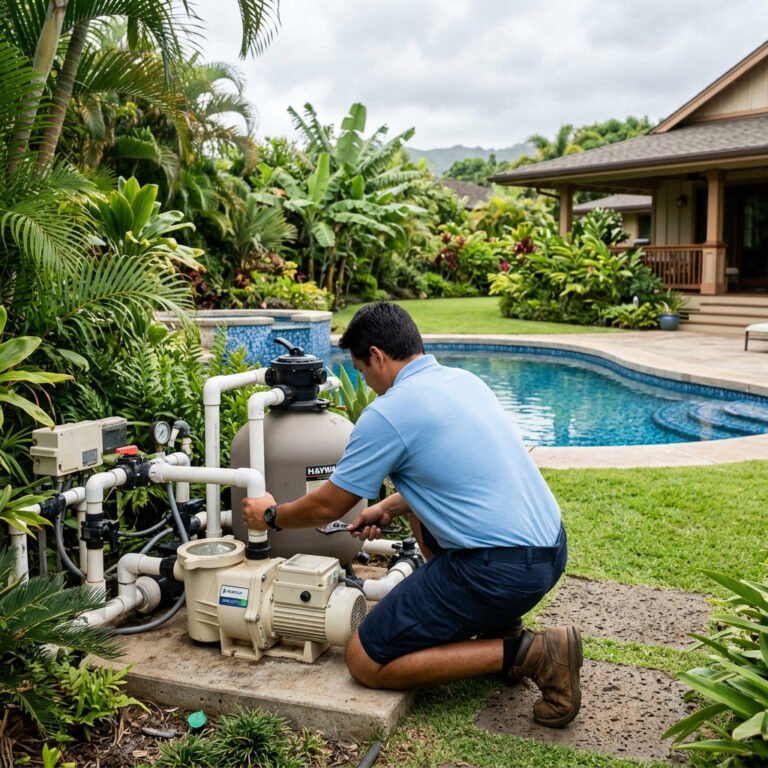
Pump Repair
The pump is the pool’s heart, and on Oahu it runs harder and longer than almost anywhere on the mainland — no seasonal downtime to rest bearings, seals, or motor windings.
Common pump problems
- Losing prime repeatedly, usually a suction-side leak drawing in air
- Motor running but little or no water flow — often a worn impeller or blocked line
- Grinding or screeching noise — typically a failing bearing
- Motor won’t start, or trips the breaker — often a capacitor or winding issue
- Visible leaking from the seal plate
The pros we work with service both single-speed and variable-speed pumps across major brands including Pentair, Hayward, and Sta-Rite. Most pump repairs come down to one of three components: the seal (the most common failure point, and usually the source of a visible leak), the impeller (wears down over years of continuous use, reducing flow even when the motor sounds fine), or the motor itself (windings, bearings, or the capacitor). Identifying which of the three is actually the problem is most of what a diagnostic visit is for — a leaking seal and a failing motor can look similar from the outside but call for very different repairs.
If your pump is still single-speed, a variable-speed conversion is one of the highest-value upgrades available on an always-running Oahu pool — it can meaningfully cut the electric bill on equipment that never gets a break.
Heater Repair
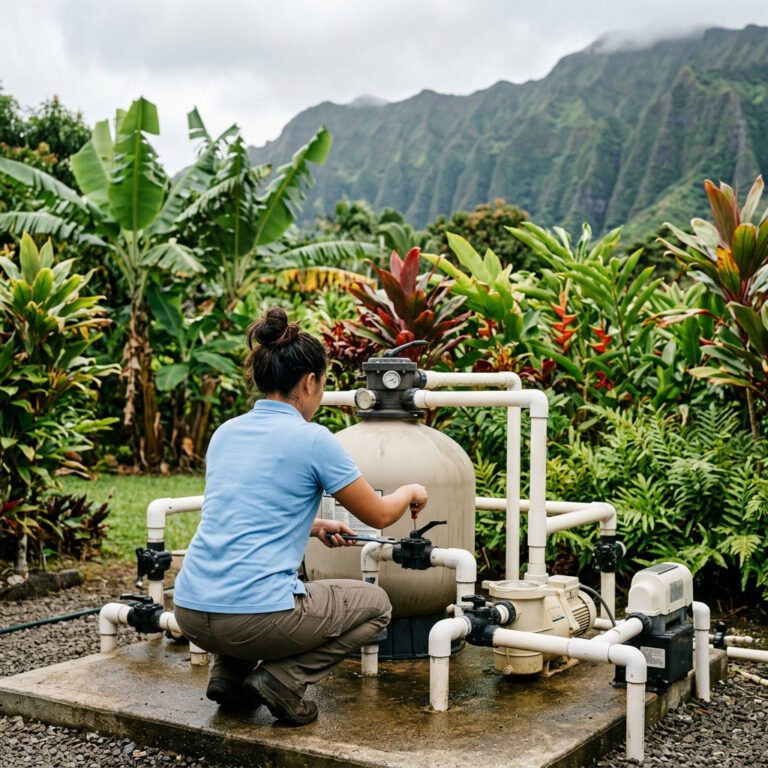
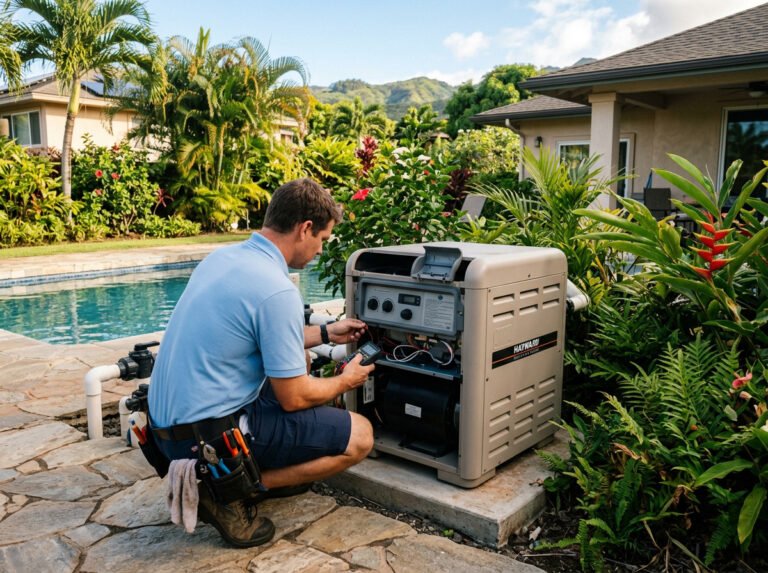
Both gas and heat pump systems see service on Oahu, and each fails differently.
Gas heater issues
- Won’t ignite, or ignites then shuts off
- Heat exchanger corrosion — a real risk in coastal salt air, even more so than inland
- Error codes specific to the control board
Heat pump issues
- Running constantly without reaching set temperature
- Compressor not engaging
- Reduced efficiency from a corroded outdoor coil — another salt-air casualty
The pros we work with are trained on Raypak and Jandy/Zodiac systems, among others, and will tell you honestly if a heat exchanger replacement makes more sense as a full unit replacement, given how much of a heater’s cost sits in that single component. The heat exchanger is worth understanding specifically: it’s the component that actually transfers heat into the water, and it’s also the part most exposed to both combustion byproducts (on gas units) and pool water chemistry — a combination that makes it the single most common point of failure on an aging heater, and the reason a “heater repair” conversation often becomes a heat exchanger conversation specifically.
Salt Cell Repair
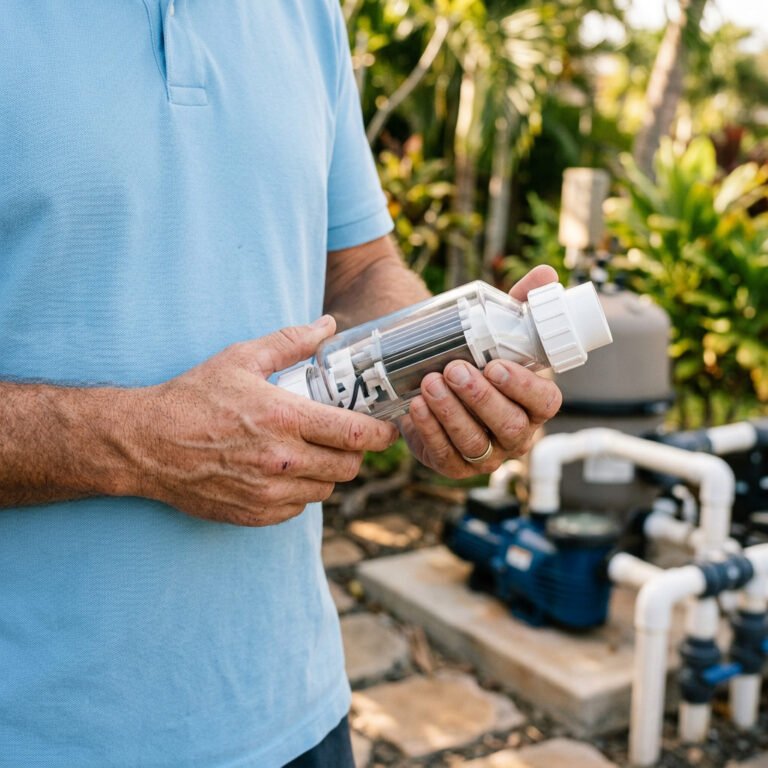
Salt systems generate their own chlorine, but the cell itself is a wear item, not a set-it-and-forget-it device.
Signs your salt cell needs attention
- Low or zero chlorine output despite correct salt levels
- Visible scaling or calcium buildup on the cell plates
- Error codes on the salt system control panel
- Cell producing chlorine inconsistently, spiking and dropping
Scaling is the most common cause of salt cell failure, and it’s worth knowing that Oahu’s water hardness varies by source across the island — a factor worth discussing with your pro if you’re seeing repeat scaling issues. Cells have a finite lifespan regardless of care, typically several years of service before replacement becomes the more sensible option than continued repair.
Pool Automation Repair
App-connected control systems add convenience, but they’re also another point of electronic failure in a climate that’s hard on electronics generally.
Common automation issues
- System won’t connect to the app or Wi-Fi
- Scheduled functions not triggering
- Control panel unresponsive
- Sensor readings that don’t match reality — often a failing probe, not the whole system
Automation troubleshooting starts by isolating whether the problem is the controller itself, a sensor, or connectivity — three very different fixes that look identical from the homeowner’s side.
Pool Light Repair
- Light not turning on — could be the bulb, the transformer, or the wiring
- Flickering or dimming
- Water intrusion into the fixture, a real risk once a seal ages
LED conversion from older incandescent or halogen fixtures is a common upgrade the pros we work with handle alongside straightforward repairs.
What Equipment Repair Costs on Oahu
Cost varies enormously by category and severity, but a few patterns hold across the industry:
- Pump repairs tend to sit on the more affordable end — a seal or capacitor replacement is a relatively contained job. A full motor replacement costs more, though usually still less than a heater exchanger.
- Heater repairs span the widest range. A simple ignition or control-board fix is moderate; a heat exchanger replacement is often expensive enough that it’s worth comparing directly against a new unit.
- Salt cell repairs are usually replacement rather than repair once a cell fails — there’s not much to fix inside a scaled or worn cell, so the conversation is really about cell replacement timing.
- Automation repairs vary the most, from a five-minute sensor swap to a full controller replacement.
- Pool light repairs tend to be lower cost individually, though LED conversion across multiple fixtures adds up.
Two things move the number regardless of category: parts availability (older or less common brands sometimes require ordering) and corrosion severity — salt-air damage occasionally means a repair scope grows once a pro actually opens up the equipment.
Who This Is For
- Homeowners with a specific piece of equipment acting up
- Vacation rental owners who can’t afford equipment downtime between guest bookings
- Weekly service clients whose pro flagged a specific issue during a routine visit
- Absentee mainland owners who need a trustworthy diagnosis without being on-island to see it themselves
- Anyone comparing repair vs. replace on aging equipment and wanting an honest read before committing either way
Why Equipment Fails Faster Here
Two Oahu-specific factors show up across every category above:
Salt air corrosion on electronics and housings
Control boards, wiring connections, and metal housings all corrode faster in coastal air — not just saltwater pool components. A control panel or automation controller a few blocks from the ocean can show corrosion damage years before an equivalent inland installation would.
Year-round runtime with no recovery period
Every category above runs essentially 12 months a year on Oahu, compared to a seasonal duty cycle on the mainland. That constant use is real, cumulative wear — not a sign anything was installed or maintained incorrectly.
What a Repair Visit Includes
- On-site diagnosis of the specific equipment and symptom
- A clear explanation of the actual point of failure, not a guess
- An upfront quote before any work begins
- Repair using parts matched to your equipment’s brand and model
- Post-repair testing to confirm the fix actually holds
- A written summary of what was done
Related Reading
For filter-specific repair — cartridge, sand, and DE systems — see Pool Filter Repair on Oahu. For the broader repair-or-replace decision framework, see the Pool Repair overview.
Frequently Asked Questions
How much does pump repair cost compared to heater repair?
Pump repairs tend to be on the more affordable end of the equipment categories above, while heat exchanger replacement on a heater is typically among the higher-cost repairs — often close enough to full replacement cost that it’s worth comparing both options.
My salt cell keeps scaling. Is that normal?
Some scaling is normal over a cell’s life, but repeat scaling in a short window is worth investigating — water hardness and pH balance both play a role, and it’s a good conversation to have with your pro rather than just replacing the cell repeatedly.
Is it worth upgrading to a variable-speed pump?
Often yes, especially on Oahu where pumps run year-round. The energy savings from a variable-speed motor tend to add up faster here than in climates with a seasonal off period.
My automation system won’t connect. Is that a big repair?
Not necessarily — connectivity issues are often a sensor or Wi-Fi problem, not a full controller failure. Diagnosis will tell you which before any parts get replaced.
Do you work on both gas and heat pump heaters?
Yes, including major brands like Raypak and Jandy/Zodiac.
Something not working right? Call or text 808-517-5612, or request a free quote below.